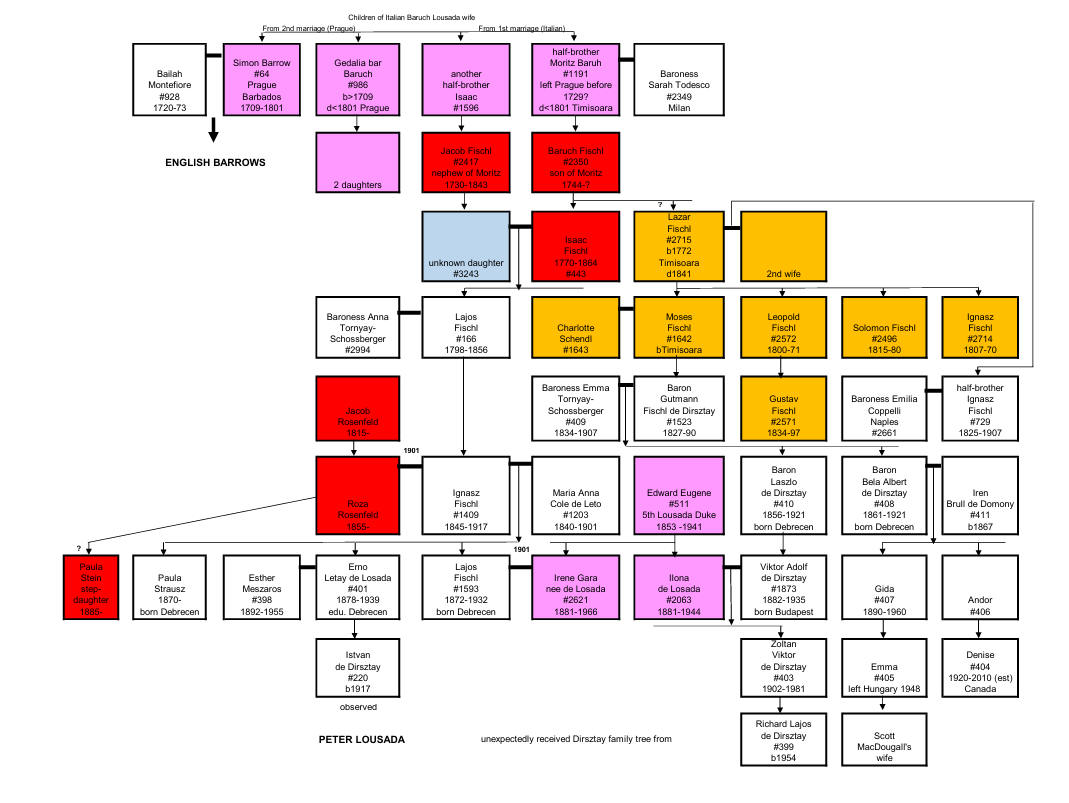
The Fischls and the de Dirsztays - with some Italian and Baruch Lousada links
The chart above is a multiply-refined extract from the family tree (ref 31) given to us by Richard de Dirsztay #399. Peter Lousada showed the tree to Julian Land in 2011, but Istvan Letay #220 unknowingly catalyzed its creation decades earlier. An early reaction to the chart was from Scott MacDougall, the husband of a great-granddaughter of Baron Bela de Dirsztay #406 and the chart was initially intended to show the connection between Bela, Istvan and Richard (see note 6 below). The 28 people shown in white come from Richard's tree but some have been moved; the extra 21 people (shown in colour) enable us to overcome mislocations and other deficiencies in Richard's tree (however many aspects of Richard's tree are confirmed by other means - see ref 399). The lower person shown in pink is the most recent Baruch Lousada ancestor (as discussed in note 1 & 6 below) of Richard's grandmother Ilona, but also shown in pink are the 2 later sons (Simon #64 and Gedalia #986 plus Gedalia's daughters) of the Baruch Lousada wife (of Baruch Lichtenstadt of Prague) whose 2 earlier sons - Moritz Baruh (shown in white) and a brother Isaac #1596 (shown in red) - make her the origin of the Fischls shown in the chart. The 9 people in red (including Isaac #1596 just mentioned) were suggested by Dena Jenkins a DNA match of Julian Land. Shown in orange are Fischls who were found online by Scott MacDougall. But 2 further people (shown in blue) are needed for genealogical connection (see notes 1, 5 & 11). Resolution of key errors in Richard's tree is explained in note 5, and the chart now tells the story of a large branch of the Baruch Lousadas.
Scott MacDougall's wife ('SW') is also a DNA match of Julian Land ('Ju'), and Scott contributed not just the 6 orange Fischls shown above, but further information as discussed in notes 5 and 6 below. Dena Jenkins contributed not just the 9 red Fischls shown above, but further information as explained in note 11 below. But we have not yet confirmed that her eminent great-grandfather Erno #401, as recounted in Richard's tree, obtained in 1922 and 1924 the right to use the 'de Losada' title and coat of arms. Our independent biographical data for him does not show this, but neither does it show 1915 Royal consent to use the 'Letay' surname as noted in ref 341. Any ab initio 'de Losada' claim would not have passed the simplest inspection; for Hungarian descent from the Duque de Losada was awkwardly timed (see note 9 below), and any attempt to take the ancestry back to Jamaica like that of the 5 Lousada Dukes would no doubt go horribly wrong - Richard's certainly did (see note 3 below). So Richard may have believed that de Leto ancestry somehow entailed de Lousada ancestry - an unwise extrapolation from his grandmother Ilona's joint ancestry (which he seemed not to have fully grasped in any case). Peter Lousada's presence in Budapest around 1980 was a spur to Richard, adding topical interest to the probable local presence until 1941 of the 5th Lousada Duke (see note 14 below). Of course the Fischls' Baruch Lousada ancestry did not go back to Jamaica but rather to Livorno and Tunis like that of the Barrows (see note 10 below). We don't quarrel with Richard's view that Moritz Baruh was the key Baruch Lousada ancestor of the Fischls, but Isaac #1596 also appears significant since his name reflects that of his likely Livorno/Tunis grandfather Isaac #1807. On the other hand, Moritz Baruh's name reflects that of Moses, the father of Baruch Lichtenstadt, suggesting that Moritz (Moses) may have been legitimately born into the 2nd marriage of the Baruch Lousada wife referred to above (while the existence of 2 Jacobs - as recorded in note 11 below - suggests that Moses was actually conceived in the 1st marriage, apparently having the same biological father - Jacob - as Isaac #1596 did).
The wives of Moritz Baruh and Simon Barrow are examples of the Italian connection in this family history. Of course before the Risorgimento all of northern Italy progressively fell into the hands of the Austro-Hungarian Empire, and the retreat of the Ottomans created business opportunities to the east of Vienna. No doubt people of Sephardic ancestry from Italy and the Ottoman Empire joined those seeking to exploit these opportunities. At this time Livorno was losing its dynamism as a trading port (see note 13 below), and Jewish Italian banking was in decline since the 1682 decision of Pope Innocent XI (ref 347). Of course, Simon Barrow would have passed through Tunis and Livorno before heading off west (ultimately to Barbados) with Gedalia remaining in Prague, perhaps being affected by the Empress' 1744 expulsion edict (see note 8 below). The sons of Isaac #1596 and Moritz Baruh were probably born away from Prague perhaps in Timisoara (see note 7 below), for their fathers appear to have left Prague before 1729. Later, in Timisoara, they acquired the Fischl name (see note 4 below). Subsequently, descendants with this name went to Budapest, where some acquired the aristocratic name 'de Dirsztay'. There were 2 marriages with the Tornyay-Schossbergers (see note 2 below) who like the de Menasche family (see note 1 below) had business interests across the Austro-Hungarian Empire and the Ottoman Empire. Such families illustrate the influence and cultivation of the Jewish aristocracy of Hungary, but much of this wealth was lost under the Nazis some of whose evil influence is captured in the de Dirsztay tree.
Notes:
Ilona de Losada is shown as the first wife of Viktor Adolf de Dirsztay but ref 398 proves that she was not the daughter of the 5th Lousada Duke Edward Eugene as shown by Richard (since her Lousada ancestry was on her mother's side) but probably of an unknown sister of Edward Eugene. Of course his appearance, and death on 5 May 1941, was a considerable surprise, for apart from the 1853 Le Havre birth record showing his parents we have no other information - discounting his 'return' to Jamaica in ref 6 p27 which gives no source (and which not only fails to question the Dukes' connection to the Duque de Losada but even more oddly implies the 5th Duke had previously been in Jamaica which is doubtful given his French birth and the somewhat illustrious European life of all his aunts, uncles and cousins). On her father's side ref 398 shows that Ilona had de Leto ancestry, presumably via brother Jakab (shown in blue) of Maria Anna Cole de Leto #1203. Richard got his grandmother's twin sister wrong (see note 6 below), but he may still have known of Edward Eugene's local presence and the date of his death (which remained unknown to English sources). Emanuel the 2nd Duke married a somewhat impecunious minor French aristocrat Honorine Scholastique Lejeune, Emma married a Belgian Count Louis van der Burch of military background, Francis was HM Consul for Rhode Island and Massachusetts and was made Marquis of San Miniato by the Grand Duke of Tuscany (his wife was on the Grand Duke's staff in London at the time, but Francis had to apply for the Marquisate and the Grand Duke seemed to pay more attention to her ancestry than his), 2 of his 3 sons becoming the 3rd and 4th Dukes (Horace Francis and Francis Clifford), Edward Eugene's father Herman married Francoise Tard of Chantilly, Berthe married Gustav Nicolai de Noe of Prussia, while Anna Marie married Edmund Molyneux-Seel who became Chamberlain to Pope Leo and Chamberlain 1st Class to Pope Pius 9. Edward Eugene's wife is given in ref 31 as Baroness Judith Menasche (which raises an interesting question) but this connection, plus the further connections above - with aristocratic Jewish families like the Naples and Sicilian Letos and the Hungarian Dirsztays - show the social value of the 'de Losada title' in this locale.
What is the relationship of Emma who married Gutmann Fischl to Anna who married Lajos Fischl? The de Dirsztay tree answers this - Anna was a daughter of Lazar Tornyay-Schossberger and Rosalia Klein, whilst Emma was a grand-daughter of Lazar by his second wife Regina Sachs and son Simon. That is, Emma was a half-niece of Anna. This pair of marriages relinks Fischl family branches.
Moritz Baruh appeared in Timisoara in the mid-1700s with an Italian wife. He was also shown in Richard's tree linked to the Jamaican Baruch Lousadas via an implausible and no-doubt invented father. Thus, he is shown as a son of Jacob Aaron (shown as son of Emanuel #135!) who married Esther Ximenes but while Emanuel #135 had a son Jacob whom we know as Jacob #139 his will showed no trace of a wife or family. Perhaps Jacob was son of an Aaron instead, but in our Baruch Lousada genealogy the only such Jacob (apart from Jacob #2570 of New Jersey who died in childhood) was Jacob #380 and he married Abigail Lamego of Jamaica and predeceased her. The only male Baruch Lousada who married a Ximenes bride was Emanuel #87 of London who married Rebecca Ximenes of Amsterdam. But the Dirsztay tree gives Rebecca's husband as Aaron another son of Emanuel #135 of Jamaica but while Emanuel #135 did have a son Aaron we know him as Aaron #141 who died in infancy!
Ref 35 chapter 2 provides an account of how the German imposition of surnames occurred.
Richard's tree makes Moritz Baruh (see top line) the father of Lajos #166 which seems impossible. With the help of suggestions from one of Julian Lands' DNA matches (Dena Jenkins - see note 11) we can quite plausibly show Lajos #166 as a grandson of Moritz Baruh. Further, in Richard's tree (ref 31) the appearance of Ignasz 1845-1917 as the son of Ignasz 1825-1907 is doubtful - and we are persuaded Richard's tree is in error by the location of the younger Ignasz as a step-brother of an older Ignasz - both shown on geni.com as sons of Lazar Fischl (who is shown above as Lazar #2715 and who was born circa 1772 in Timisoara). Lazar is one of the 6 people shown in orange and is an ancestor of Scott MacDougall's wife, for while the Dirsztay tree (ref 31) gives Lajos #166 as the father of Gutmann this appears to be another error as on 22 Mar 2015 Scott MacDougall pointed out that Bela's father Gutmann has a father named Moses on geni.com, with the father of Moses being Lazar Fischl. The chart links Lazar #2715 with Moritz Baruh and his brother Isaac #1596 with the help of our key hypothesis that Baruch #2350 the father of Isaac #443 was also the father of Lazar #2715 (given the similarity in birthdates of Isaac #443 and Lazar, and the likely Timisoara birthplace of both). Online we find that Lazar is a fairly close family member - Julian Land has found a DNA match with someone both connected to Lazar Fischl and to Abraham (a son of Simon Michael) Pressburg. In addition, further connections can be found online between Julian Land and both Lazar Fischl and Baron Gutmann Fischl de Dirsztay.
Bela de Dirsztay (1861-1921) was the great-grandfather of Scott McDougall’s wife, and on 19 Feb 20 Scott was able to confirm some details of Bela's descendants. Thus Bela's grand-daughter Denise did indeed get to Canada and was married with no children; she died around 2010 and that Scott and his wife used to see her regularly. Emma, Scott's mother-in-law fled to Canada around 1948, and that her mother Luyza indeed died before WW2. Most interestingly, Richard's tree shows incorrectly that Emma did not survive WW2, but correctly shows that Emma's brother didn't. Richard presented Peter Lousada with the de Dirsztay tree after Peter had provided Richard with the tree shown in ref 85; their contact was probably initiated by Istvan Letay observing Peter Lousada, who was on a business trip to Budapest, and then reporting this observation to Richard. Istvan and Richard appear to have been second cousins once removed via their de Leto ancestry (and perhaps their relationship also involved Istvan passing information to Richard on a paid basis). Iren Gara #2621 was the sister-in-law of Erno #401, but presenting her as Ilona's twin sister was an unnecessary error. How Richard used her as the model for the twin of Ilona #2063 is revealed in ref 31 - Richard's guilty trail involved Ilona being given 2 birthdates and 2 deathdates one pair of which closely matches Iren's birthdate (exactly) and deathdate (the next year) and the other pair of dates does not match being 2 days earlier (birthdate) and 22 years earlier (deathdate)! While ref 399 confirms that Ilona had a twin, no details about her are given, but when ref 399 notes that Ilona herself was sometimes also known as Iren, Richard's error becomes even starker! Some more errors were made by Richard as shown in note 12 below - these perhaps being more understandable.
Timisoara became associated with the Austro-Hungarian Empire after its conquest in 1716 by Prince Eugene of Savoy except for a brief period of Ottoman rule in 1778-9. Perhaps after the 1716 conquest, there was Italian and Jewish investment in Timisoara.
Ref 66 observes that the expulsion of 1744/5 probably led to an increase in Jewish immigration to England - and perhaps Timisoara similarly gained Jewish population as we suggest here. Ref 66 also argues that English diplomacy had little to do with the partial reversal which was more to do with local reaction and the valuable social role the Jews played in the Empire. We suggest that Baron Moses d'Aguilar may have had a role given his access to the Empress; Michael Silber has spoken on this (ref 386).
Of course, as the lifespan of the Duque de Losada was 1706-83, and his title was created in Naples in 1741, Erno would not have wanted close inspection of his purported link, for at the time at which Moritz Baruh was born ie in the 1700-1710 period there was no Duque de Losada!
To explain the belief of the Barrows that they descend from the Baruch Lousadas, we developed an early Barrow link with the Baruch Lousadas centering on a Baruch Lousada wife of Baruch Lichtenstadt, father of Simon Barrow of Barbados. As Baruch Lichtenstadt is not known other than in Prague, it may be that his wife came to Prague from Italy and soon became a widow with 2 sons - Isaac and an unborn (and as yet unnamed) Moritz, Isaac becoming a stepson of Baruch and Moritz Baruch becoming a legitimate brother of her later sons Simon and Gedalia. Perhaps Richard's evident belief as to his own Baruch Lousada ancestry derived from a family legend, reawakened by the Budapest presence (prior to 1941) of the 5th Lousada Duke, and the Budapest visit of Peter Lousada around 1980! That is, both the Barrows and Fischls seem to have retained an enduring belief in their Baruch Lousada ancestry without retaining knowledge of the supporting evidence! It is also quite possible that the Jamaican Lousadas - from whom the 5th Duke descended - were unaware of the Livorno dimension of the Baruch Lousada story we recently discovered, hence the concocted Jamaican ancestry we reveal in note 3 above.
Dena Jenkins a DNA match of Julian Land has been in touch and believes the Fischls in the chart above are among her ancestors, because the placenames which appear in Richard de Dirsztay's tree match her family history. Also, Erno #401 and his brother Lajos are central to her family history; on 10 May 2024, she advised that she is certain that she descends from Erno. Her contribution consists of the 9 people shown in red, and gave the dates where shown including gravestone evidence of 2 of them - an Isaac was said to be a son of a Baruch, and a Jacob was said to have been a son of an Isaac. Dena Jenkins cited ref 341 in giving Lajos Fischl #166 as a son of a Jacob, but ref 341 also shows that Jacob's father is Moric (Moritz). Clearly there were 2 Jacobs - Jacob #2417 (Dena's 4*great grandfather) the son of Moritz Baruh as implied by ref 341, and Jacob #3277 the son of Isaac #1596 as implied by Dena's gravestone data. The person in blue - the wife of Baruch #2350 - is suggested as a daughter of Isaac #1596, thereby making Isaac #443 the son of Baruch also a grandson of Isaac #1596. (Baruch #2350 derived his name from Baruch Lichtenstadt the probable legitimate father of Moritz Baruh). Dena Jenkins also pointed out another wife of Ignasz Fischl #1409, and it seems that Roza Rosenfeld must have been the 2nd wife taking into account the 1901 death date of Maria Anna Cole de Leto and the fact that Roza remained attached to the memory of Ignasz after his death (which ref 31 shows to have been in 1917). It will be seen that there are 2 daughters named Paula - the younger, Paula Stein who wrote a history of the Rosenfelds, must have been a step-daughter of Ignasz. Also, the 1901 marriage record for Lajos and Iren (as reported by Dena Jenkins) gives Iren's parents as Leo Gara and Lina Schack and the parents of Lajos as Ignasz and Roza. The second marriage of Lajos #1593 must have also taken place early in 1901, on a date between the death of Maria Anna Cole de Leto and the marriage of Lajos and Iren which was on 20 Feb 1901. Lajos was obviously a stepson of Roza.
There is uncertainty over the dates of the birth of Laszlo and Victor Dirsztay, for ref 342 and ref 344 give alternative dates for the birth of Laszlo and we show 1856 above reflecting the 9 May 1856 date given by ref 342, with a date 6 days earlier offered by ref 344, and not the 1860 date in ref 31. We continue to show the Debrecen birthplace of Laszlo given by ref 31 (which also shows Bela born in Debrecen) rather than Budapest which is offered by ref 344, but we favour the Budapest birthplace for Victor offered by ref 342. The 1922 deathdate of Laszlo in ref 31 is rejected in favour of the date of 4 Jun 1921 authoritatively given by both refs 342 and 344. Ref 342 notes the published uncertainty over Victor's birthdate with dates in the range 1883-9 found. For the moment we show the 1882 date of ref 31 but perhaps he was born after his sister Charlotte who was born in 1883.
The Italian dimension may extend to diamonds, but things changed once sea routes to India were established, for few Indian diamonds then made their way through Livorno. As ref 84 p125 points out, in the mid-18th century the London Ashkenasi Jews had few contacts with Livorno and thus did not use Mediterranean coral to trade for Indian diamonds (see note 9). In any event, the Sephardic Livorno merchants in the 1700s progressively concentrated on cross-Mediterranean trade rather than Atlantic trade (ref 64). Of the Italian Jewish families in the diamond trade who moved to London in first half of the 1700s were the Francos (with whom there were 2 Lousada marriages) and the Levy Sonsinos (with Montefiore and Barrow marriages). Another dimension was silver supplies from Genoa (see ref 377).
The 5th Lousada Duke is shown by the chart above as the uncle of Richard's grandmother Ilona. He may have died naturally at age 88 in 1941, but Ilona's daughter Ana did not survive the Holocaust. However, ref 398 credits Ilona's international contacts with helping Zoltan escape Axis territory, so that he (and son Richard) survived.